Yesterday Google Killed SEO (and What Comes Next)
The biggest announcement at Google I/O didn’t make the headlines because nobody had the guts to say it out loud.
Google just quietly pulled the plug on its own multi-billion-dollar golden goose. AdWords.
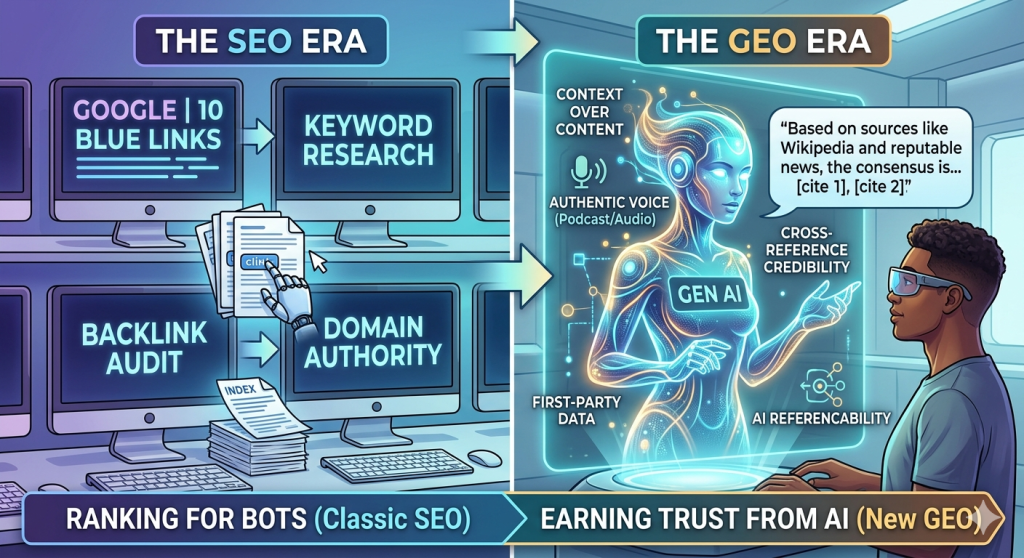
The traditional era of SEO—Search Engine Optimization as we’ve known it for twenty years—is officially dead.
And with it, the foundation of AdWords is shifting beneath our feet.
But if you’re panicking, you’re missing the plot. This isn’t a funeral; it’s the birth of something infinitely more powerful.
Welcome to the era of GEO: Generative Engine Optimization.
Moving Beyond the “10 Blue Links”
For two decades, marketing was basically a game of trying to trick a search bot. We obsessed over keyword density, bought backlinks, and did everything we could to squeeze our way into those coveted “10 blue links” on page one.
But let’s honest: consumers don’t want a list of links anymore.
They want an answer.
With generative search, the user isn’t digging through ten different blogs to fix a leaky faucet or find the best CRM software.
The AI does the heavy lifting, synthesizes the data, and delivers a clean, definitive answer.
If your marketing strategy relies on a bot crawling your site just to dump you into an index, your traffic is about to hit zero.
The game has changed. You are no longer optimizing for a search spider; you are optimizing to be referenced by an AI.
The New Rule: Think Like an AI, Not a Bot
GEO isn’t about gaming a system; it’s about earning algorithmic trust.
When Claude, Gemini, ChatGPT, or Perplexity formulate an answer, they rely heavily on Retrieval-Augmented Generation (RAG).
They are looking for the absolute most credible, cross-referenced sources on the planet to ensure they don’t hallucinate. They are pulling from mainstream media, Wikipedia, older authoritative domains, and deeply trusted primary data.
The Reality Check: In this new world, context matters more than content.
If you want to be the brand that the AI recommends, you have to be the undisputed consensus across the web. You need to exist where the AI trains and where it verifies.
The Return of the Authentic Voice (Literally)
Here is the twist that absolutely fires me up: this new wave is a massive win for authentic creators, journalists, and public relations.
Because AI is rapidly becoming a voice-first interface (think Gemini Live or GPT-4o), we are entering a phase that looks a lot like the pre-search engine marketing era.
It’s almost like the golden age of radio.
We aren’t going to be staring at screens typing keywords; we are going to be having spoken conversations with our assistants while we walk down the street.
When a user asks their AI assistant for a recommendation, the AI isn’t going to read off a list of options. It’s going to name one or two.
To win that single, conversational slot, you have to know how to actually write and create original, deeply authentic written and spoken-word content.
The flood of generic, AI-generated SEO slop?
It’s useless. It’s noise.
The algorithms are smart enough to bypass it to find the human heart at the center of the data.
The Pivot Is Now
Is Google abandoning ads? Of course not. They are a business.
But those ads are evolving from clunky top-of-page banners into highly integrated, native recommendations baked directly into the AI’s thought process.
The opportunity here for startups, agencies, and forward-thinking marketers is astronomical. We are looking at a completely blank canvas.
The old playbook told you to convince Google to rank you, or pay an influencer to talk about you.
The new playbook?
Convince the AI to trust you.
It’s a whole new world. It’s fast, it’s disruptive, and it is incredibly exciting. See you on the other side.


Leave a Reply