Pip: A fashion magazine sequel turns out to be a meditation on algorithmic takeover — which, honestly, tracks.
Mara: Giselle Bisson has been writing about exactly that collision: where AI meets the industries that run on human taste, judgment, and creative labor. That’s the territory we’re covering today.
Pip: Let’s start with the film itself — and what it’s actually arguing.
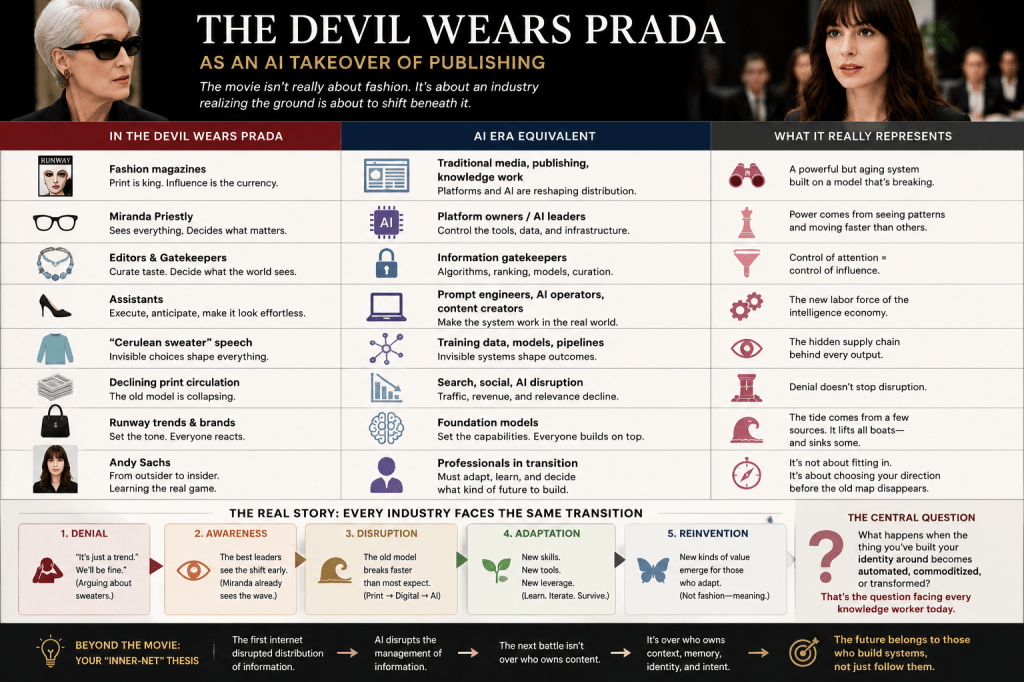
The Devil Wears Prada 2 Is Really About AI
Mara: The central question here is whether human curation has any defense against a tech billionaire who sees it as an expensive inefficiency — and a Hollywood sequel turns out to be where that argument gets staged.
Pip: The post sets up the pivot point precisely. Miranda meets the buyer expecting a corporate transition, and instead gets a manifesto. The line is direct: Benji intends for human creativity to simply “submit” to the automated wave.
Mara: That reframes the whole film. What looks like a fashion industry drama is actually a referendum on who gets to decide what culture looks like — a human editor with obsessive standards, or an algorithm optimizing for data.
Pip: And the villain is doing real work here as a composite — orange-faced, Silicon Valley-adjacent, named Benji Barnes. The post calls him a nihilistic Elon Musk slash Jeff Bezos-style figure, which is doing a lot of heavy lifting without technically naming anyone.
Mara: His literal plan is to fire the entire editorial staff and replace writers, editors, and fashion models with generative AI. The post is specific: articles, editing, page layout, the models themselves — all automated.
Pip: So Miranda Priestly, famously the most difficult person in any room, becomes the argument for why difficult human judgment is worth preserving. That’s a genuine reframe.
Mara: The post frames it exactly that way — Miranda’s high-standard, obsessive curation, however punishing to work under, represents something worth fighting to protect against what the script calls AI slop.
Pip: The resolution is that Miranda and Andy have to recruit a competing buyer — Sasha Barnes, played by Lucy Liu — to intercept the deal before Benji’s vision takes hold. The film’s climax is literally a bidding war over whether a magazine gets a soul or a server rack.
Mara: What the post is really tracing is how screenwriter Aline Brosh McKenna used the sequel’s corporate plot to map something happening right now in actual journalism and publishing — the automated, algorithmic shift that has already cost real editorial jobs.
Pip: A fashion sequel carrying the weight of an industry’s existential argument — that’s either ambitious filmmaking or a sign the argument has nowhere else to go.
Mara: Either way, the question of what human curation is worth doesn’t stay in the theater. More on that next time.


Leave a Reply